
Do self-help books actually help?
Understanding why self-help books sell, and what they really do

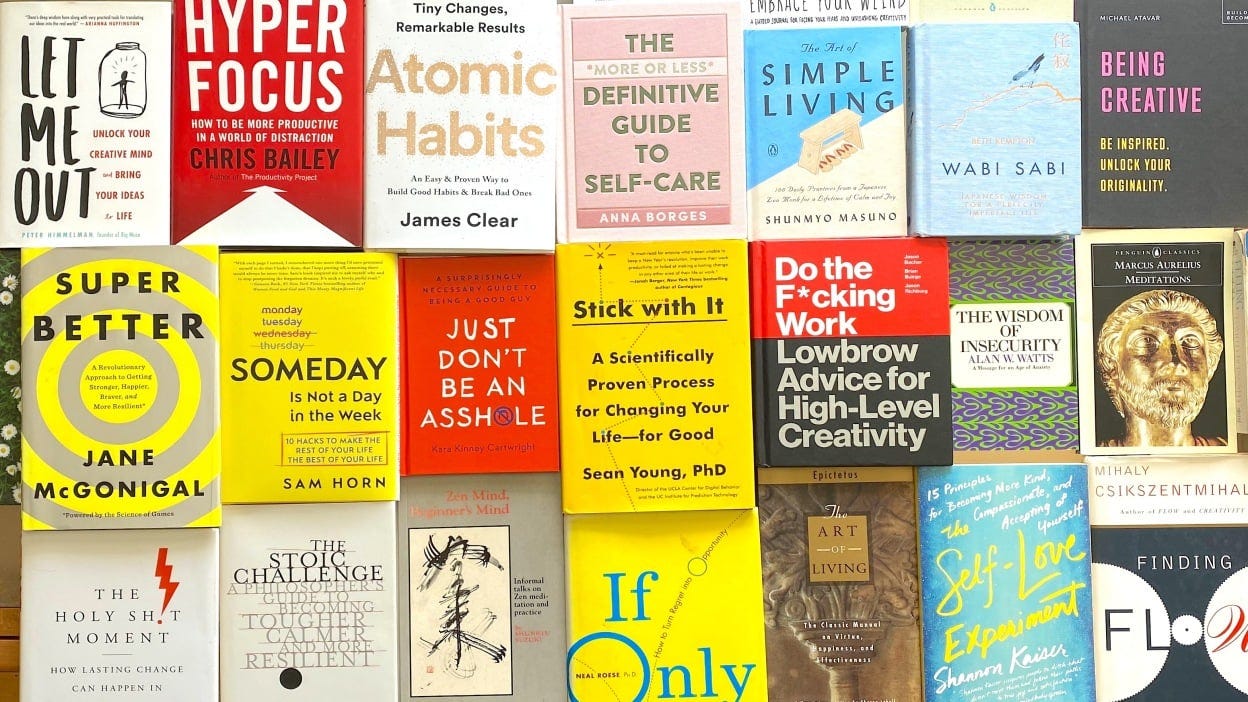
I was browsing through a small bookstore a few days ago (only 4 shelves!! — but that’s a story for another time), and was surprised to find an entire shelf allocated specifically for the self-help genre. It made me wonder: Are self-help books so popular that they need to cover a quarter of a bookstore? And should they be given that much importance?
Today’s topic is a bit of a detour from what I usually like to talk about, but I found this so interesting, I couldn’t resist. Time for a trip down psychology lane…
The main issue
Self-help books refer to books created for the purpose of advising readers (usually through a set of tools or actions) about how to solve personal issues, improve skills or achieve particular goals. They can be about almost anything, from losing weight, to navigating relationships, to getting accepted into your dream university.
Why do self-help books sell?
Self-help books tap into the inherent desire of all humans to be better. We all want to improve, but we don’t know how. Like any good advertiser, self-help books boast of “quick fix” solutions, where minimal effort is required to achieve maximum results.
Some psychologists suspect self-help books address the fear of failure we all have. This fear can lead to a relentless goal of being a “perfect” person — which isn’t always healthy. By charting out roadmaps for success and creating life plans, they make us believe we’ll become immune to faults.
Oftentimes, famous personalities write books outlining their paths to success or the things they do (supposedly) that improve their lives. This builds credibility, or ethos, because everybody wants to become their role models. Be honest with yourself. If you saw a book Taylor Swift (or any celebrity you like) wrote, would you not buy it?
The “sides”
😀 A. Emotional Understanding
Self-help books help people understand how and why they’re feeling something, often similar to a therapist or counsellor. They give people clarity on their thoughts and emotions.
They don’t judge poor choices. Instead, they mollify readers, by making them understand they’re not the only people doing something a certain way, and drive them to break the habit.
😀 B. Guided Improvement
When people want to do something but don’t know how, a self-help book is a great place to start out. They provide the structure, routine and motivation people need to work towards their goals. It’s like having a life coach in the form of a book.
They can also encourage positive habits, such as regular exercise, and improve skills, such as communication.
☹️ C. Solo Journey
A major issue with self-help books is the self part. They can encourage people to believe all problems are personal failures, which is both demoralising and misleading.
They can encourage people to rigorously work on themselves alone, rather than being supported from friends and family — which is key to achieving any goal. They can also discourage getting professional help, if required.
☹️ D. Self-Fixing Spiral
This genre is marketed on people’s feelings of dissatisfaction, perfectionism and self-doubt. Any bombastic title can remind people of their faults and insecurities, and with the way self-help’s popularity is increasing, these reminders are everywhere.
These books sometimes lead one to believe they’re broken — and need to be fixed. People can end up defining themselves as their shortcomings rather than their real personalities.
What we need
We need to achieve our goals, solve our problems, and become overall better people. But, we also need to remind ourselves of our value, pace ourselves in our pursuits, and reduce our internal pressures. It’s important not to race through solutions… and slowly pick up new problems along the way.
Here are some ways to strike a balance:
Pick a book and stick to it: If you intend to read a self-help book, pick ONE. There are so many out there that it’s impossible to actually focus on one, and the lessons it teaches us. Zeroing in one topic and making a tangible difference is better than over-consuming multiple books and learning nothing.
Slow and steady wins the race: There’s no need to finish your book in one week, or even one year. An interesting idea would be to read one chapter, organise and execute plans to implement the solution in your life, and only move to the next once you’re confident you can do it regularly. This ensures proper action is taken without speed-running.
Use your friends and family as self-help guides: The people who know you best are also the people who can tell you what your problems are, how you’re feeling, and what you can do about it. You might not even need a self-help book — just one productive conversation with a loved one can enlighten you!
Self-help books can act as the seeds to success, but what makes those seeds grow is purely personal action and motivation. And to grow, we need more than just one tool — we need support from our loved ones, our surroundings, and our own selves.
So, maybe the question isn’t: Which book plants the best seeds?
It’s more like: How do we grow strong trees?
References
Hannah, Sophie. “Why I’m Addicted to Self-Help Books.” The Guardian, The Guardian, 18 Sept. 2020, www.theguardian.com/books/2020/sep/18/why-im-addicted-to-self-help-books. Accessed 6 Aug. 2025.
Khadija. “The Dark Side of Self-Help.” Ualberta.ca, 2022, www.ualberta.ca/en/youalberta/2022/01/the-dark-side-of-self-help.html. Accessed 6 Aug. 2025.
“Pathos, Logos, and Ethos.” STLCC, 2025, stlcc.edu/student-support/academic-success-and-tutoring/writing-center/writing-resources/pathos-logos-and-ethos.aspx. Accessed 6 Aug. 2025.
“Every Self-Help Book Ever, Boiled down to 11 Simple Rules.” Mashable ME, 25 July 2020, me.mashable.com/entertainment/11111/every-self-help-book-ever-boiled-down-to-11-simple-rules. Accessed 6 Aug. 2025.
Such an interesting perspective! There’s so much focus on the ethical use of AI, the environmental impacts, its influence on the jobs market… but this is an important one to consider as well!